When a team is not delivering, the first explanation that arrives is the easiest one: we hired the wrong people, they need more motivation, they are not stepping up. Sometimes that is true. Far more often, capable people are trapped inside a structure that makes good performance almost impossible, and no amount of pep talks or performance reviews will fix a structural problem.
If you have replaced people and the same problems came back with the new ones, that is your clue. The constant is not the people. It is the system they are working inside.
The three structural causes hiding behind "underperformance"
1. Ownership is unclear
When a task does not have a single, named owner, it does not get owned. It gets half-done by whoever has capacity, or it falls into the gap between two people who each assumed the other had it. From the outside this looks like people dropping the ball. It is actually a design where the ball was never handed to anyone. Performance requires that every piece of work has an owner before it starts, not after it goes wrong.
2. Nobody has decision rights
If your team cannot make a call without checking with you, they will stop trying and start waiting. That looks like a lack of initiative. It is really a lack of authority. People need to know which decisions are theirs and the criteria for making them. Without that, every decision escalates, work stalls in the queue behind you, and your most capable people slowly learn to behave passively because deciding is risky and asking is safe.
3. The channels are wrong
When the urgent and the trivial arrive on the same channel, nothing has the right weight. Decisions get buried in chat, important context is lost, and people miss things not from carelessness but from noise. A team drowning in unstructured communication looks disorganised. It is actually under-structured. The right message on the right channel is not admin. It is the difference between a team that is aligned and one that is guessing.
Is it structure, not talent?
It's almost certainly structural if:
- You've changed the people and the same problems returned.
- Work regularly stalls waiting on a decision only you can make.
- Tasks fall through the cracks between team members.
- Your team waits to be told rather than taking initiative.
- Important things get missed in the chat scroll.
Why performance reviews won't fix this
Reviews, incentives and motivational pushes all assume the problem sits inside the individual. When the real constraint is structural, those tools push against the wrong thing and the team feels blamed for a system they did not design. The fix is not to manage people harder. It is to give the work clear owners, give people real decision rights, and put the right message on the right channel, so capable people can finally perform like the capable people they are.
Install the execution structure once
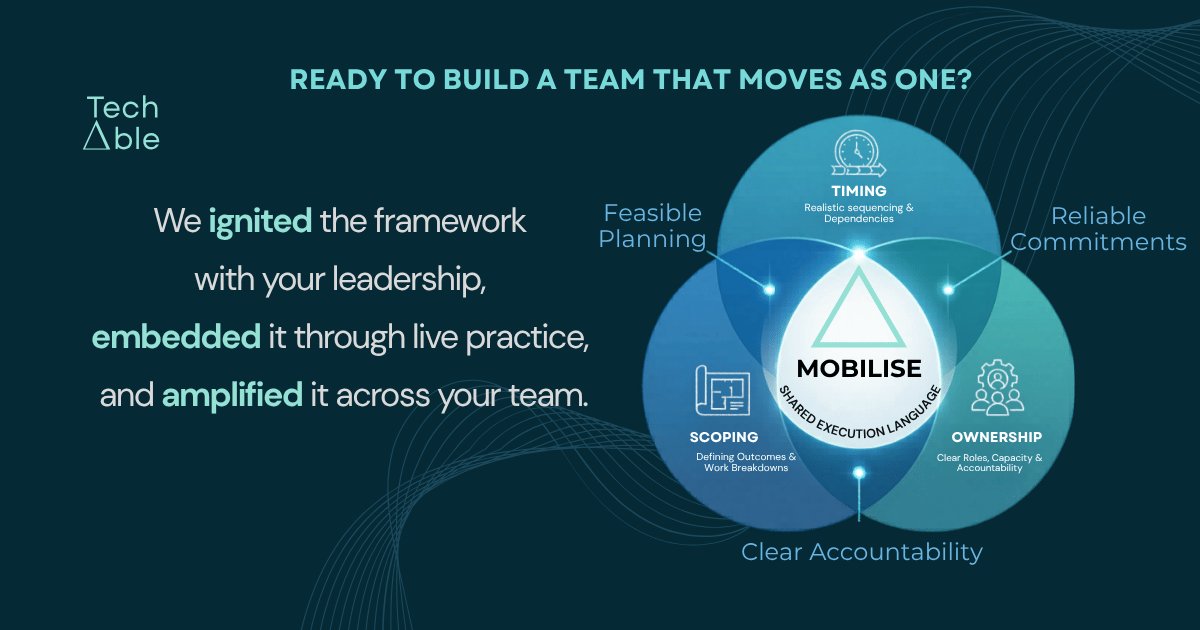
This is what Mobilise is built to do. It installs the execution capability your team needs to run without constant direction: the task-scoping and ownership frameworks so every piece of work has a clear owner, the communication structures that put the right message on the right channel, and the decision-making models that stop every call escalating back to you. It is delivered across three tiers: Ignite to lay the foundation, Embed to practise live on your real work, and Amplify to roll it out across the whole organisation. The result is a team that delivers without you in the loop on every decision. Or explore all three TechAble services.