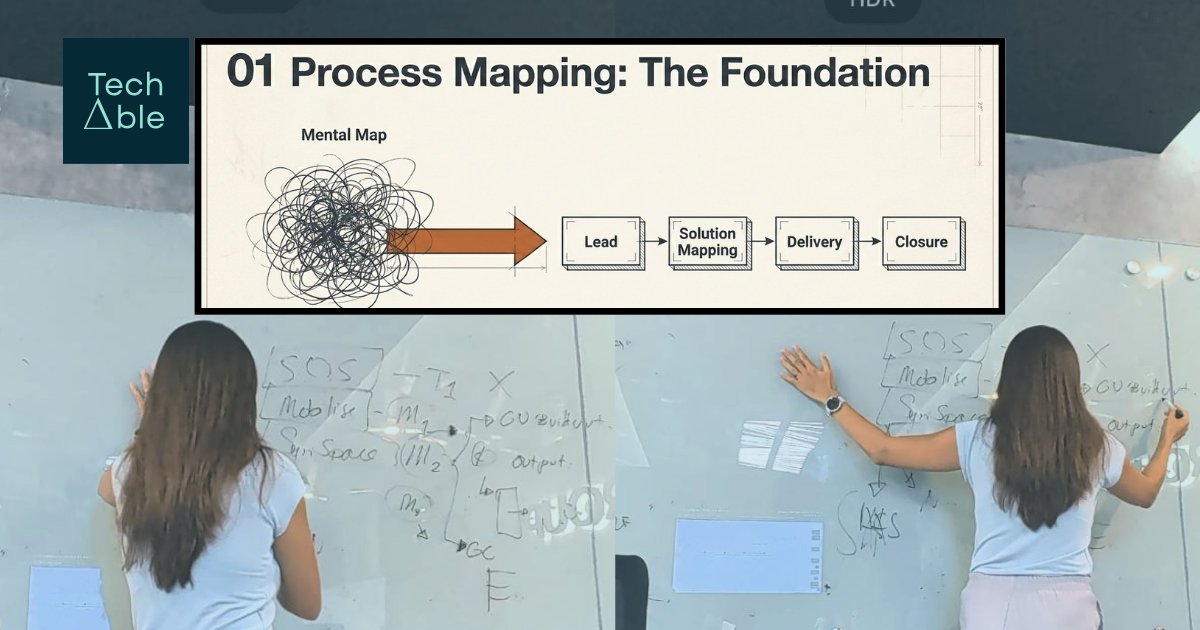
"You should map your processes" is good advice that almost nobody acts on, and for a sensible reason. When people picture process mapping, they picture a months-long project to document every workflow in the business, most of which are working fine. It feels like enormous effort for unclear payoff, so it sits on the someday list forever. Meanwhile the actual problems keep recurring.
There is a far better way in, and it starts from the opposite end. Instead of mapping everything in the hope of finding the trouble, you start at the trouble and map only backward from there. The friction you already feel is a signpost pointing at exactly the process worth examining. Follow it, and you reach the break quickly.
Why pain is the right starting point
Every recurring frustration in a business is the visible end of a process that is not working. The late deliverable, the dropped handover, the thing that always needs redoing, the question that keeps coming back. These are not random annoyances. They are symptoms with a cause somewhere upstream, and the symptom tells you which process to follow. You do not need to map the healthy parts of the business at all. You need to map the path that leads to the pain.
This is why pain-led mapping is so much faster than the document-everything approach. You are not boiling the ocean. You are pulling one thread at a time, and each thread leads straight to a fixable cause.
How to map backward from the friction
- Name the pain precisely. Not "things are chaotic" but "proposals go out late" or "clients chase us for updates." A specific symptom gives you a specific thread to pull.
- Trace the steps that lead to it. Work backward from the symptom. What happens just before? And before that? Keep going until you reach where the work actually starts. You are drawing the real path, not the ideal one.
- Mark every handover and decision point. The breaks almost always hide where work passes between people, or where it waits for a decision. Note who does what, and where it stalls or drops.
- Find where it actually breaks. Somewhere on that path is the real cause: a step with no owner, a handover nobody confirms, a decision that always waits. That point, not the symptom, is what you fix.
- Compare the map to reality. The break is often not where anyone assumed. The map turns "it feels chaotic" into "here, exactly, is the step that fails," which is the moment a vague problem becomes a fixable one.
Good pains to start mapping from
Pick the one that costs you most:
- Work that regularly ships late.
- The task that always comes back needing rework.
- The handover that keeps dropping between two people.
- The question clients or staff keep having to ask.
- The thing that only goes smoothly when you're personally involved.
Why mapping alone isn't the finish line
Seeing the break is the first half. The second half is knowing which break to fix first, because a growing business usually has several, and they are not equal. Some cost you a fortune in lost time or clients; others are merely irritating. Mapping shows you where the problems are. Ranking them by impact shows you where to spend your limited attention. Do the mapping without the ranking and you risk fixing the loud problem instead of the expensive one.
From map to ranked plan
This is the heart of what the S.O.S. Roadmap does, at the scale of your whole operation. Rather than mapping a single pain, we map your entire lead-to-client lifecycle, surface every gap in process, ownership and handover, and rank them by impact. You leave with sub-process maps, SOP recommendations, Executor Profiles and a prioritised plan, so you are not just looking at where things break but holding a clear, ordered list of what to fix first. The pain that prompted you becomes one entry on a map that shows the whole picture, with the highest-value fix at the top. Or explore all three TechAble services.